I Can’t Escape

I can’t escape
The wheel turns over and over and over never stopping
Even when it slows so I can catch my breath, it is still not enough to jump off
Do I really want to get out then?
I say that I do. I want to believe that I do. But what can I do?
I can’t escape

I can’t escape
You are my child, you are a part of me
How to I cut off a part of me?
Surgeons can take my body parts but who can take my soul, my heart?
Who do I see to untangle us?
I can’t escape

I can’t escape
I love you; then hate – Thank you; then hurt – Help me; then silence
When do the lies stop? Where is the truth?
I can’t see clearly enough
I can’t escape
I can’t escape
I can’t


lea austen

Buttons

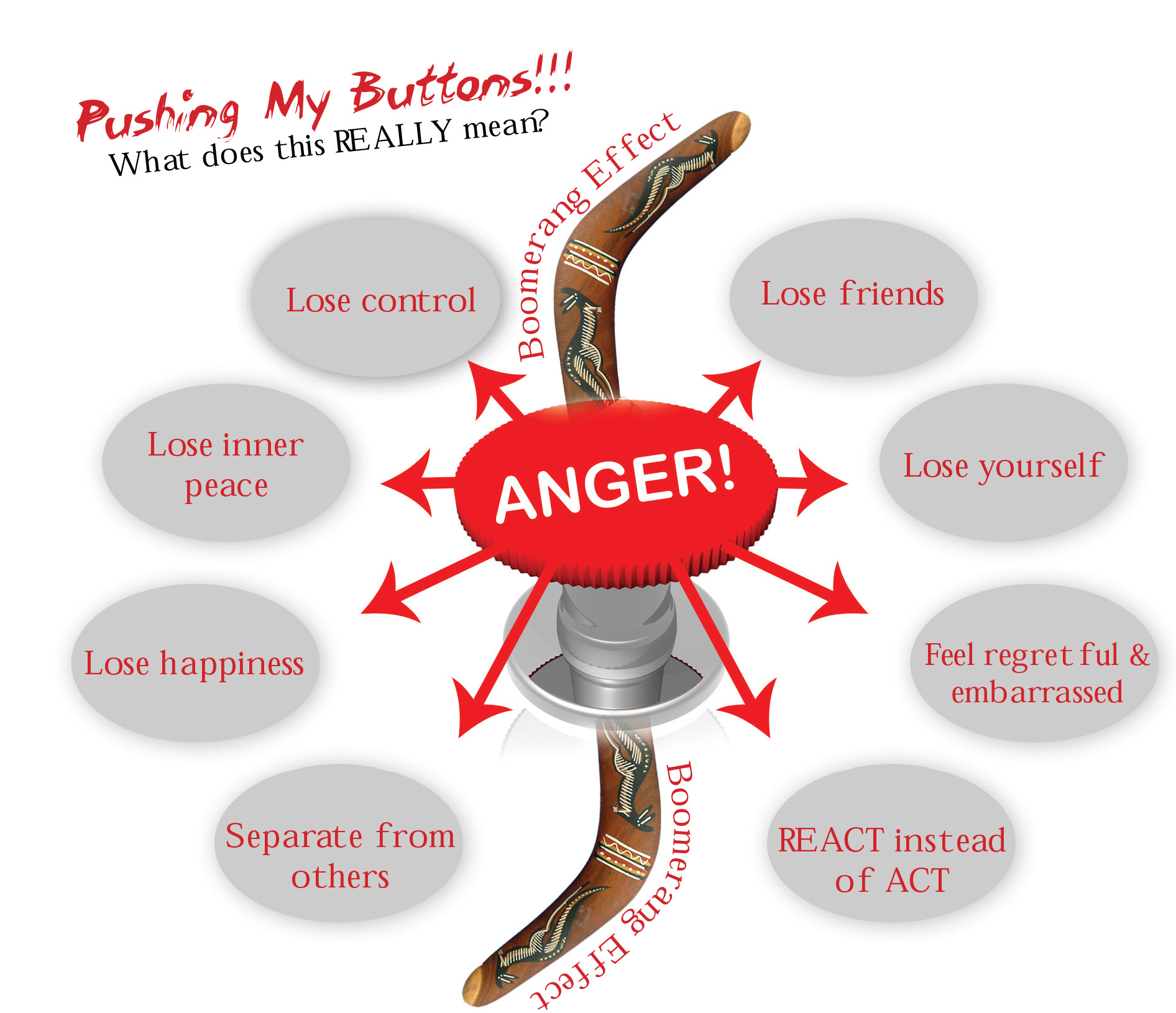
pushing-buttons  Do you have people in your life who love to push your buttons?  Lord knows I do.  Why do we allow one telephone conversation or text message put us in an emotional and psychological tailspin that can last for hours or even days?

Many would say this is where detaching with loves enters the picture.  If we step away perhaps we can learn how to react to the button pusher in a more effective way.  Remembering that we can’t control what they do or try to do, but we can gain some control over our own reactions.  Hold your arm out away from your body.  Now reach back and touch your shoulder with your hand.  You should be looking at your elbow.  If you draw a line from your elbow to the floor, that space directly in front of you is about all you can really control so STOP trying to control others.  Their patters, particularly their patterns with us, are their issues.  How we react are our issues!  Simple, practical right but insane too that we keep circling the same tree.

We CAN take care of our loved one without feeling guilty.  We can be assertive without being aggressive.  We can set boundaries without being disloyal.  Finally, we can learn to love this person without giving up love and respect for ourselves.

Here are some tools that might help.  They come from lifehack.org


1. Understand that your buttons are your buttons.

Buttons are the things (ideas or subjects) that make you react in a certain way. We all have areas of sensitivity and I am pretty sure we know what they are.

2. Learn to steer the conversation away from sensitive subjects or areas.

When you are in a situation where someone is heading into the danger zone for you, the smart thing to do is to steer the conversation away from the area of your sensitivity. This is a skill that you can learn and it will give you power in any conversation.

Many people can be insensitive or inadvertently push your buttons. Many times you can cope with this behavior by changing the subject. For example, if someone brings up a subject that is a sore point for you. You simply ask the person something about himself, preferably something that he is interested in. People love to talk about themselves and the communication about the sensitive area will be completely forgotten.

3. Educate the people close to you what your buttons are and find out theirs.

A very good thing to do at the beginning of any close relationships such as newlyweds or fiancés would be to sit down and go over areas that might be sensitive. Then at least, when you wade through the minefield, you know where the mines are. You are less likely to have one explode in your face. It is also good to make an agreement that you will never use these areas to intentionally hurt the other person no matter how angry you might be.

4. If something has really upset you, go somewhere quiet and regroup.

Sometimes these things take us by surprise and it can be difficult to regain our composure. The best thing to do when that occurs is to go somewhere by yourself and regroup. Do not react when you are severely upset. Wait until you have calmed down enough to figure out a good way to handle the upset.

Nothing good comes from blindly reacting from a painful place. Pain creates pain in these instances and the impulse might be to hurt that person in return. This starts a chain reaction of negativity and you always feel terrible afterward.

Breathe, dry your tears and go turn the situation around.

5. Understand that a person’s hurtful comments have nothing to do with you.

They really don’t, no matter what the other person is saying.

If the person is being nasty, that is NOTHING to do with you. It is ONLY in his or her own universe and comes from his or her own personal pain.

The best thing you can do when this occurs is to recognize that the nasty person in front of you is not the real person. Granted there are some people who are like this all the time and are best avoided but the majority of people are just doing their best with a huge lack of workable tools to fix unhappy situations. They don’t like acting the way they do any more than you like having to deal with it.

Just look beyond the hurtful comments of these desperate people and take the opportunity to help him or her solve the problems. Get them to talk and be interested in finding out the real problem. If they are just too angry or verbally abusive, let them know that you will try to help when they calm down and then you can have a real conversation. Being able to pinpoint problems and help others to do so is a valuable skill. Those around you rightly perceive you as a valuable ally and value you.

6. Understand that certain relationships have buttons in common and need extra care and consideration.

Specifically, I am talking about the familial relationship. So many times these can get off on the wrong foot and make you both miserable. In close relationships, there is shared pain, and buttons come from pain. This pain can then create patterns of behavior that are destructive

Understand that just because patterns are set early in a relationship does not mean they have to remain that way during the relationship.

7. Recognize that another’s behavior may be the result of limiting beliefs, prejudices, opinions and generalizations.

And guess what! You don’t have to explain yourself, justify yourself or in any way prove that you are a good and decent person!

Even if you did, this person would not see it anyway because all he or she sees is his or her own limited views.

You are not responsible for someone else’s prejudices or generalizations. Let it go and move on.


Be Like Coffee

2118538

The following story is taken from seewhatweseee.com:

This is a good lesson for all of us, no matter what stage of life you’re in. You’ll see what I mean.

A young woman went to her grandmother and told her about her life and how things were so hard for her.  She was tired of fighting and struggling. It seemed as soon as one problem was solved, a new one arose.

Her grandmother took her to the kitchen. She filled three pots with water and placed each on a high fire. Soon the pots came to boil. In the first she placed carrots, in the second she placed eggs, and in the last she placed ground coffee beans. She let them sit and boil; without saying a word.

In about twenty minutes she turned off the burners. She fished the carrots out and placed them in a bowl. She pulled the eggs out and placed them in a bowl. Then she ladled the coffee out and placed it in a bowl.

Turning to her granddaughter, she asked, ‘Tell me what you see.’

‘Carrots, eggs, and coffee,’ she replied.

Her grandmother brought her closer and asked her to feel the carrots. She did and noted that they were soft. The grandmother then asked the granddaughter to take an egg and break it. After pulling off the shell, she observed the hard boiled egg.

Finally, the grandmother asked the granddaughter to sip the coffee. The granddaughter smiled as she tasted its rich aroma. The granddaughter then asked, ‘What does it mean, grandmother?’

Her grandmother explained that each of these objects had faced the same adversity: boiling water. Each reacted differently. The carrot went in strong, hard, and unrelenting. However, after being subjected to the boiling water, it softened and became weak. The egg had been fragile. Its thin outer shell had protected its liquid interior, but after sitting through the boiling water, its inside became hardened. The ground coffee beans were unique, however. After they were in the boiling water, they had changed the water.

“Which are you?” she asked her granddaughter. “When adversity knocks on your door, how do you respond? Are you a carrot, an egg or a coffee bean?

Think of this: Which am I? Am I the carrot that seems strong, but with pain and adversity? Do I wilt and become soft and lose my strength?

Am I the egg that starts with a malleable heart, but changes with the heat? Did I have a fluid spirit, but after a death, a breakup, a financial hardship or some other trial, have I become hardened and stiff? Does my shell look the same, but on the inside am I bitter and tough with a stiff spirit and hardened heart?

Or am I like the coffee bean? The bean actually changes the hot water, the very circumstance that brings the pain.. When the water gets hot, it releases the fragrance and flavor. If you are like the bean, when things are at their worst, you get better and change the situation around you. When the hour is the darkest and trials are their greatest, do you elevate yourself to another level?

How do you handle adversity? Are you a carrot, an egg or a coffee bean?

May you have enough happiness to make you sweet, enough trials to make you strong, enough sorrow to keep you human and enough hope to make you happy.

The happiest of people don’t necessarily have the best of everything; they just make the most of everything that comes along their way. The brightest future will always be based on a forgotten past; you can’t go forward in life until you let go of your past failures and heartaches.

When you were born, you were crying and everyone around you was smiling. Live your life so at the end, you’re the one who is smiling and everyone around you is crying.


I was faced with a difficult decision yesterday.  In the middle of being tested I was beginning to feel like the carrot.  After using a few of the tools I have cultivated that help me including speaking with my husband and taking time in prayer, I was able to turn it around to be like the coffee.

May we all be like the COFFEE.

When you least expect it….

aamilne_n_fotor

What can we expect?  What happens even with our best efforts? Why does it always appear?  What shows up is the unexpected.

Face it.  We don’t like it.  Don’t want it.  Didn’t ask for it or plan on it interrupting our lives.  But the unexpected shows up anyway and when it does we have no choice but to deal with it. Life is full of surprises and unexpected turns, and if this causes you anxiety and stress, and affects your mind, moods and behavior, you need to find a way to be less affected by them.

Those unexpected or surprise events happen with relative frequency.  Sometimes they last but a brief moment perhaps the length of a phone call, but other events force us to deal with the event over a period of time and can become quite annoying like a wart or bug bite you pick at or itch.  This week I had one of those long, drawn out unexpected life circumstances that I pray will be resolved soon. The circumstances involve a number of people and I have thought about how the events have unfolded and how each of us have handled the issues.  We all have had to make agreements and compromises and with any luck, we will have a resolution this week! I just hope the next unexpected interruption is a more pleasant one.

So how do you handle surprises and unexpected events?

Do you become stressed?
Do you panic?
Do you get flustered?
Do you become angry?


10 Tips for Dealing with Surprises and Unexpected Events:


  • Acknowledge the fact, and learn to accept that surprises and unexpected events are part of life and are unavoidable. When you accept this fact, to some extent, it will be easier to deal whatever happens in your life. Life is dynamic, not static. Change is part of life, and the sooner you acknowledge and accept this fact, the better it would be.
  • The key to everything is your attitude. Having a positive attitude is an asset in unexpected situations. Not all unexpected events are negative. Sometimes, what seems like a problem, or even a disaster, could be a blessing in disguise. A negative event can awaken ambition, motivation, and persistence, which would lead to progress and success.
  • When making a plan, always have an alternate plan, in case the first plans fail. This would prevent you from falling into a state of helplessness, fear, and not knowing what to do next. Plan B might just save you!
  • Wait for a few moments, before blurting out when confronting unexpected or unpleasant turns of fate. Before getting angry or panicking, look at what happened and assimilate the news. In many cases, this might something of minor importance that is easy to cope with. Maybe what happened is temporary, or something that can be easily fixed.
  • If what happened is irreversible, what good would you gain by becoming angry, stressed or panicked? You would gain nothing. Instead of getting flustered and confused, angry or feeling helpless, it would be much more useful to think constructively where you are going from there. You need to think how to adjust to the new situation and either fix it, improve it, or make the most of it.
  • Take the initiative, and introduce small changes into your life. Sometimes, in small and not important matters do things differently, without premeditating about them. This will help you cope more easily with surprises and events that are out of your control. In this way, you teach yourself to accept change. For example:

    – Take a different route to your work in the morning.

    – Eat a different breakfast.

    – Drink tea in the morning, instead of coffee.

    – Decide on the spur of the moment to go to a movie with your husband or friend.

    – Do things that you usually do, but in a different way.

  • Always focus on the present moment, living it the best, learning from it the most you can, and taking advantages of new opportunities that come your way. All there is, is the present moment, therefore, make the most of it, instead of thinking about what you lost, thinking about the past, or dwelling on how bad the situation is. This approach is useless and is a waste of time.
  • A certain degree of emotional detachment is important. It helps you take a step back from problems, surprises and expected events, and therefore, to be less affected by them. This helps you stay calm and in control of yourself, and therefore, be in a better position to deal with whatever is happening in your life.

    Attachment causes you to cling to the familiar, and makes you fear letting go. Too much attachment allows surprises and unpleasant events to have a greater negative effect on you.

  • Build a solid foundation of inner strength.  A state of inner strength brings stability, and a better control of your mind and actions, so that you can cope with any situation. This you can do by training and strengthening your willpower and self-discipline, two of the main pillars of inner strength.
  • Learn and practice meditation.  Even just 10 minutes of meditation every day can make a great change in your life, making you feel, calm, relaxed, and unperturbed by the events in your life. A certain amount of inner peace is most welcome in every situation, and meditation is one of the foremost ways leading to inner peace.

When you are calm, possessing inner peace, emotional detachment and inner strength, external events lose their power over you. You stop getting agitated and losing your composure, when surprises enter your life, and also when you face unexpected situations.  To get there requires some work and training. If you answered the questions with negative behaviors please consider learning to handle your unexpected events in a more positive and productive way.

I want to give credit to Remez Sasson for his insights.


Good Morning World!

new day

I needed to remind myself of this today.  Wow!  What a roller coaster week it has been.  Looking back, I handled some things well, some things okay and then some things… well let’s just say it’s over now and I am not going to look back or try and fix what is broken.

In my head I find myself saying things like, “On Monday I am going to start eating right.  No more ice cream.”  Or, “Okay, after I get through this (event) I am hitting the gym on Tuesday and Thursday and will go to the yoga studio on the other days and I will not schedule anything over those times.” How about, “I am going to (do this good thing) after I (achieve this other thing that may never happen because you do not have control of it).” I feel like I am in constant negotiations with myself!  It’s insane.  Do you do that?

One of my favorite times of the day and places to be is on the beach.  If you have never walked along the ocean at sunrise please put it on your bucket list immediately!  There is something so pure about the beach untouched in the early morning.  The sand is smooth, untouched by human feet.  The curves of the dunes and the patterns in the dry sand created by the wind are new every day.  The smoothness of the wet sand and shells peppering the ocean line are gifts from the tide.  If you stand still and close your eyes your body starts to move and breathe in rhythm to the waves ebbing and flowing.  Above the sounds of the water, birds can be heard and then there is the moment when the sun comes up along the horizon.  The light in the sky begins to change and the colors explode.  Really, you can’t help but smile just a little and you feel good!  It seems to me to be one of nature’s moments of gratitude and I have been given the gift of sharing it with nature.

So here is the cold hard truth.  Today we will do some really great things.  They may be for ourselves or for others or both.  We will do some things that we really don’t want to do but let’s try and do them with a generous spirit.  Today we will avoid things that need our attention and we will do things that may not have been our best choice.  I want to pray that those things we do that are not our best will be fewer than they were yesterday and more than they will be tomorrow.

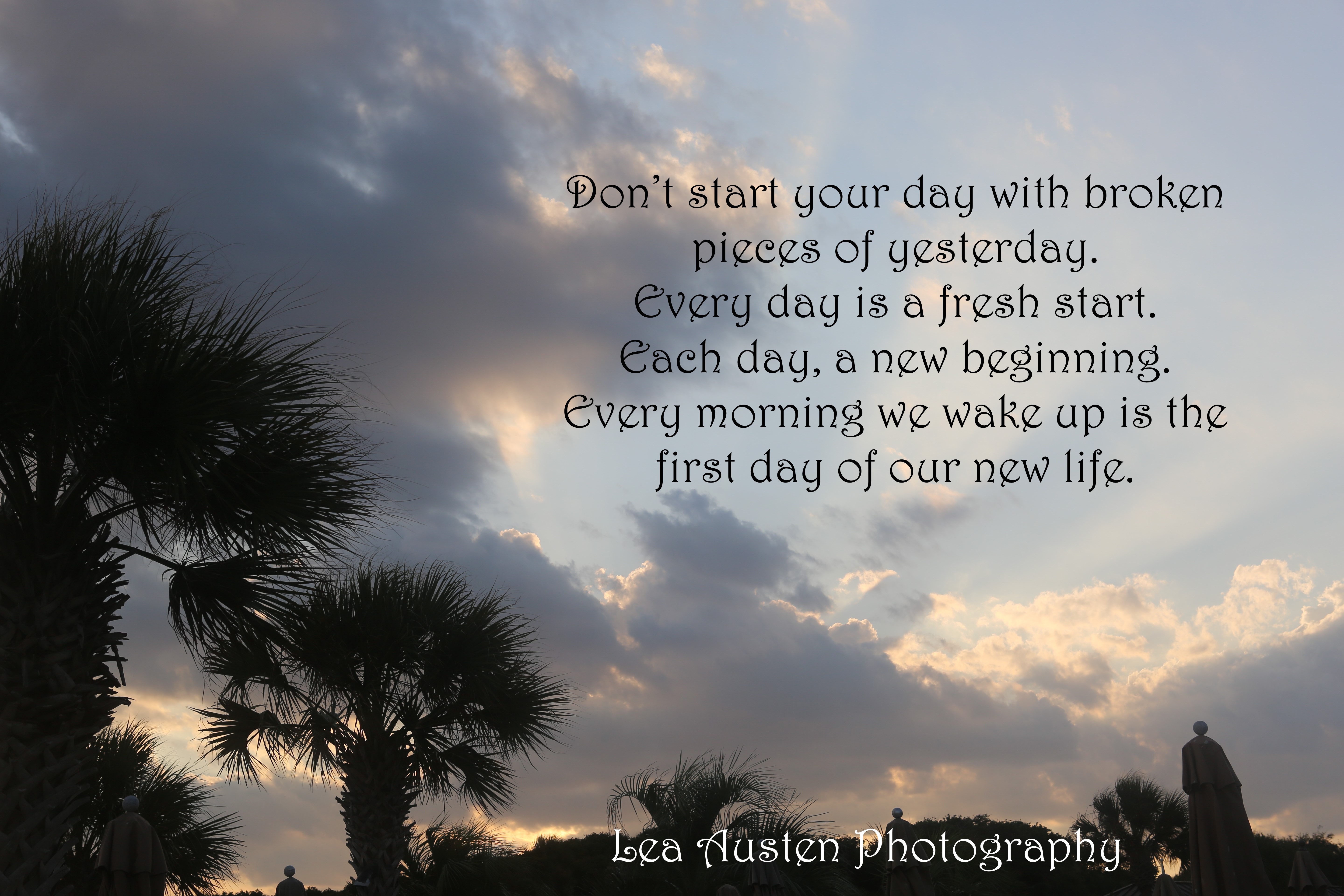
Here’s to today!  A new day.  A fresh start.


Worry – It’s a Waste of Time

Stop The Worry!

“When you begin to worry, go find something to do. Get busy being a blessing to someone; do something fruitful. Talking about your problem or sitting alone, thinking about it, does no good; it serves only to make you miserable. Above all else, remember that worrying is totally useless. Worrying will not solve your problem.” ~ Joyce Meyer

I love Joyce Meyer!  Her ministry is very valuable to me personally and if you have never heard her speak or read her books you should make time to do so.

The mind is such a powerful tool. The mind, if used rightly, can help us craft and shape our lives in a loving, beautiful and meaningful way. Used wrongly however it can be very destructive, damaging our level of confidence, our relationships and the quality of our lives.

In this powerful video, Alan Watts, who in my opinion is one of the most inspiring people I have come across, speaks about the importance of letting go of worry and compulsive thinking. A really powerful and inspiring message.


Worry is like a bamboo forest or that weed that won’t die!  Once acquired, the habit of worrying seems hard to stop. We’re raised to worry and aren’t considered “grown up” until we perfect the art. Teenagers are told: “you’d better start worrying about your future”. If your worries aren’t at least as frequent as your bowel movements, you’re seen as irresponsible, childish, aimless. That’s a “responsible adult” game rule. To the extent that worrying is learned/conditioned behavior, it can be undone.

The “How-To” on ending the Worry Game:

  1. The Worry Sheet:  There’s a useful gimmick to help stop worrying. You simply cultivate the habit of postponing worrying. Your mind becomes (re-)conditioned to not dwell on worries in the present.  The trick is that whenever you feel plagued by a worrying thought, note it down on a “worry sheet” (a piece of paper set aside for the purpose) – you can then forget about it, knowing that you plan to worry later. This simple technique can be very effective because your mind is “fooled” into thinking that you haven’t given up worrying. Meanwhile, you lose the habit of worrying in the present moment. You can plan to revisit noted worries at a time when you’re worry-free. Or you can postpone worries indefinitely. That might sound bizarre, but then so is the notion that you must experience endless unhappiness (or worrying) before you’re allowed to be happy. More likely is that when using this technique you will simply forget your original worries – they will never have bothered you.
  2. Take Time to Clear Your Head: Even the most overworked adult can find half an hour once a week to set aside for quiet meditation and reflection. Meditation is a powerful technique for organizing your thoughts and feelings, and all it requires is a quiet spot without many distractions. Sit comfortably and focus on your breathing until the rest of your thoughts become quiet. That way, you can go over them without feeling overwhelmed by them. Personally I check out completely and go to a yoga class!
  3. Be Rational: We worry about things we have limited control over, such as whether or not we got a new job (after an interview) or what a new acquaintance really thought of us, or will out mentally ill loved one have a good night or bad day. These worries are hard to help completely, even though it’s obvious that worrying won’t change their outcomes. However, that doesn’t mean you can’t do your best to remind yourself not to worry. Make a conscious effort to focus your attention elsewhere, and let events take their course as best you can.
  4. Change things Up: Pick anything you’ve always wanted to do, want to do better, or want to start doing again, and give it a shot. The things you try don’t have to be flashy, or significant to anyone except you. You could take up a new hobby, such as knitting or martial arts, or you could just make a commitment to smile more often at work. The goals you set are yours to attempt and achieve. Pursue anything you’ve ever wanted to pursue. You’ll be delighted with the results more often than not.
  5. Live in the Moment: Don’t obsess about the future; instead, focus on living in the present. It’s fine to plan ahead sensibly and set goals, but the important thing is living your life as it is now, and not worry about what is already past or what the distant future might hold.
  6. Count Your Blessings: Like most old adages and proverbs, this one gets repeated ad infinitum because it’s actually very wise advice. Set aside your resistance to clichés for a moment and think about all the advantages you have. You’re reading this article on the Internet, which means you either have or can borrow Internet access. It also means you can read, which is something not everybody can do. All but the most hopeless and pitiable lives have an abundance of good in them. Find yours, and remind yourself to be grateful for it every day.  Have an Attitude of Gratitude!  I also list what I am grateful for on a regular basis.  Sometimes it is as simple as I slept for more than four hours or the sun was shining!
  7. Trust Yourself: At the end of the day, there are some things that nobody can really control: weather, death, natural disasters, and other such unstoppable forces are a part of life on Earth. Learn to place faith in your own ability to handle them. You can’t change the way such things behave, so all you can really do is to prepare for them, and to trust in yourself to do what you can when faced with them. And, make a conscious effort to remind yourself that other people, like you, are more capable than they realize, and that you don’t always need to be there for everyone at every turn.


There is a Balm in Gilead

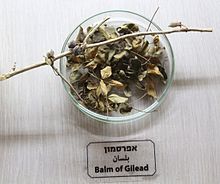
Balm_of_Gilead_IMG_97811 “There Is a Balm in Gilead” is an African-American spiritual that compares the healing balm to the saving power of Jesus—the one true treatment that never fails to heal our spiritual wounds.

There is balm in Gilead, To make the wounded whole ;

There’s power enough in heaven, To cure a sin-sick soul.


A balm is an aromatic, medicinal substance derived from plants. Gilead was an area east of the Jordan River, well known for its spices and ointments. The “balm of Gilead” was, therefore, a high-quality ointment with healing properties. The balm was made from resin taken from a flowering plant in the Middle East, although the exact species is unknown. It was also called the “balsam of Mecca.” Myrrh is taken from a similar plant—Commiphora myrrha.  The Bible uses the term “balm of Gilead” metaphorically as an example of something with healing or soothing powers.

“Balm of Gilead” has three references in the Bible. In Genesis 37:25, as Joseph’s brothers contemplated how to kill him, a caravan of Ishmaelites passed by on their way to Egypt from Gilead. In their cargo were “spices, balm, and myrrh.” Jeremiah 8 records God’s warning to Judah of what Babylon would do to them. Upon hearing the news, Jeremiah laments, “Is there no balm in Gilead?” (verse 22). His question is a poetic search for hope—a plea for healing. Then, in Jeremiah 46:11, as God describes an impending judgment on Egypt, He taunts them: “Go up to Gilead and obtain balm, O virgin daughter of Egypt! In vain have you multiplied remedies; there is no healing for you!”

 
Carrying a wounded spirit? 

Some times something has happened in our lives that has knocked us back and from which we have been unable to rise above, or get totally free from. When we are afflicted by a wounded spirit we are unable to step out boldly to obey the Holy Spirit, and therefore so much of God’s purposes for us are lost in our inability to release faith in a consistent manner. The subject of a wounded spirit is an important one, as it affects so many people. Many don’t even understand what it is, or how it affects us.

We can endure all kinds of physical illness, but when our spirit is wounded – and a wounded-spirited person is someone who has been hurt and bruised and/or damaged in their spirit – it can be very painful.

A wounded spirit comes as a result of a re-action to negative words, events, actions, or a violation of your person or rights – a re-action that crushes you, knocks you down and from which you cannot seem to rise.  It crushes an area of your life – your spirit – which is quite devastating in how it affects us. It seems we cannot heal ourselves of a wounded spirit. We need someone else to release it in positive, believing prayer.

What it can look like.

  1. Split Soul/ Self Rejection – When we suffer from lack of self worth we don’t know our value.   Autoimmune disorders are a classic example of self-hatred and self-rejection. Arthritis is another example of self-rejection
  2. Severed Soul/ Abuse and Ritualistic Abuse – The person can develop what is known by medical professionals as Schizophrenia, Bipolar or Split personality disorder.  Mental illnesses are formed from severe traumas when they are bestowed upon individuals. What is interesting though is how families can suffer with the same mental illness and not be inflicted with the same severe traumas.
  3. Never Being Good Enough/ Fractured Soul – The word fracture means broken. When people reject us or criticise us this creates a wound.   We need to forgive ourselves for not meeting the expectations that are put upon us.
  4. Shattered Soul/ Dissociative Identity Disorder -THIS IS MY LOVED ONE.
    According to Wikipedia DID is a mental disorder characterized by at least two distinct and relatively enduring identities or dissociated personality states that alternately control a person’s behavior.  Symptoms range from common lapses in attention, becoming distracted by something else, and daydreaming, to pathological dissociative disorders such as psychosis. A psychotic break according to Wiki is someone who loses contact with reality. Symptoms can range from harmless delusions, to violent outbursts and major depression. The sufferer may also be unable to distinguish reality from fantasy.  Traumas fragment the soul.  DID is when the whole soul shatters and breaks. It is the worst kind of damage.  People with this disorder can never repair themselves – there is no reparation outside of Jesus. Man can pick up the pieces with drugs, occult means and self-help measures but this only repairs with glue.  Jesus wants to not only repair but make whole and brand new.

    How does this happen?  Continual abuse until the soul can no longer protect itself.  It can be through trauma, rejection, violence, abuse.  It is all things combined until one breaks.  DID is not one particular thing but many. In DID the soul has spit the dummy.  It can no longer function.  Everything breaks down.  The physical body needs the soul to survive. The spirit/soul and body are intertwined.  Like a well-oiled machine when one is out it affects everything as a whole. For Jesus to heal this disorder you need to forgive and bless those who have wronged you.

    I found these listed on a website “The Christian Connection.”  It was very interesting to read and more in depth than I reposted here.  You may want to read more and say the prayers that go along with these.  I stand in the gap for my child.  Knowing that a belief in God is not there for her will not deter me from being the bridge.

So when I was in church today with my husband and an anointing was offered for the oil of healing I stood in her place. To be completely honest here, I really wanted to go twice!  Once for me and once for her.  I know I suffer too from a wounded soul.  This week I will pray for the wounded souls, mine and those I love.  Join me.

In Gratitude.

Calgon, Take Me Away!!!

Caring for a loved one strains even the most resilient people. If you’re a caregiver, take steps to preserve your own health and well-being.

Definition According to Webster:  care·giv·er
ˈkerˌɡivər/

noun

North American
noun: caregiver; plural noun: caregivers
  1. a family member or paid helper who regularly looks after a child or a sick, elderly, or disabled person.
Definition According to A Caregiver:
  1. a punching bag
  2. an oppressive, overpowering, demanding and practical individual that is insane enough to keep coming back for more
  3. the main character in “Groundhog Day”

Seriously, we need to find some humor in this.  Laughter is the best medicine, right?  We have one of the toughest jobs.  I would venture to say that most people honestly do not know what we go through physically, emotionally and mentally.  How many of us wonder if WE have a mental problem!  Think about it.  We have just come through an episode with our loved one.  Perhaps we are in the eye of the storm and we know at any moment the hurricane will hit again.  We are trying to process the event, make some sense of feelings and emotions and events that we just don’t understand.  We can easily do our own swirling.  Our friends and lifelines who support us have NO idea how to help us while we have NO idea how to help the one who is causing all the ajida.

Let’s look at the signs of stress. If you have at least three of these it is time to let “calgon take you away.”  And if you really don’t know what that means, you are of the more modern generation.  For us more mature caregivers y’all are with me here!

Risk factors for caregiver stress include:

  • Being female
  • Having fewer years of formal education
  • Living with the person you are caring for
  • Social isolation
  • Having depression
  • Financial difficulties
  • Higher number of hours spent caregiving
  • Lack of coping skills and difficulty solving problems
  • Lack of choice in being a caregiver

Now the signs of caregiver stress:

  • Feeling overwhelmed or constantly worried
  • Feeling tired most of the time
  • Sleeping too much or too little
  • Gaining or losing a lot of weight
  • Becoming easily irritated or angry
  • Losing interest in activities you used to enjoy
  • Feeling sad
  • Having frequent headaches, bodily pain or other physical problems
  • Abusing alcohol or drugs, including prescription medications

So, tally it up peeps!  Now what do we do about it?  I would love to say, okay I am now going to be a man.  I am going to become an MD-PHD-EFG-ESQ-ECT.  I am going to move out.  I am going to follow my best friend around and listen to Bob and Tom 24-7.  I will go out and buy my lottery ticket and wait to win!  I am going to add hours to my day and finally watch every season of ER on Netflix.

Strategies that might actually help:

  1. Accept help.
  2. Focus on what you are able to provide.  We are not perfect and we can only do what we can do at any given time.  So forgive yourself.
  3. Set realistic goals.  Prioritize.  Make lists.  I love lists!!  Learn to say “NO”
  4. Get connected.  There are resources out there for you and for them.
  5. Join a support group.  We need validation and encouragement.  Find people who know what you are going through and support each other.
  6. Look for social support.  Take walk with friends.  Be around people who are non-judgemental and will offer you emotional support.
  7. Set personal health goals.  Eat.  Sleep. Drink (water preferably) and exercise.  I have found that a good kick boxing class along with yoga make a nice balanced routine.
  8. See you doctor.

Well, I am going to take my bath now.  I will be praying for all of you that you find some peace and relaxation.

Be the Light

light in the darkness

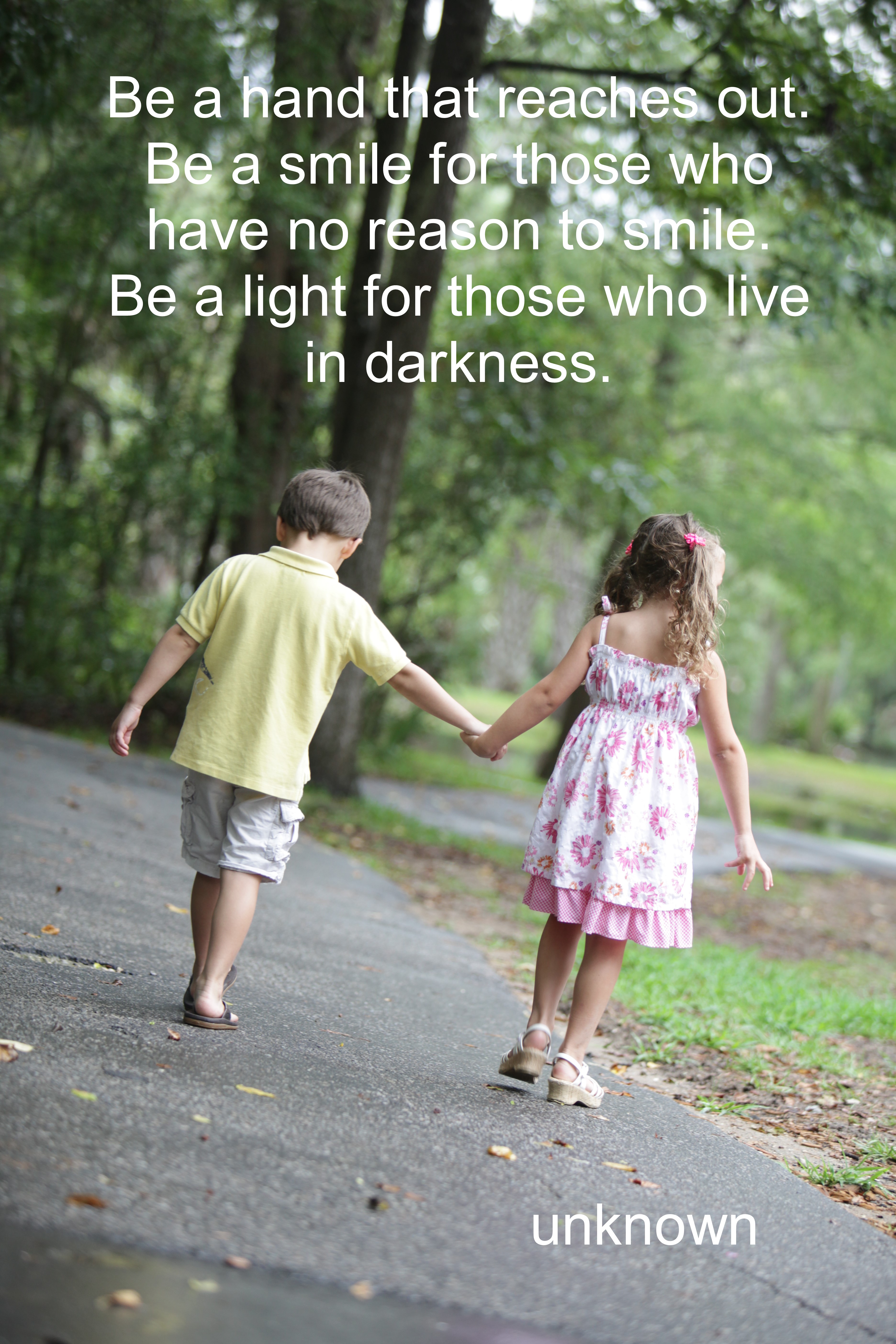
I took this sweet photo of two friends several years ago now.  I was asked by a client to meet me at a local park so I could photograph two children as a surprise for their parents.  I thought it was amazingly sweet.  She was not the mom, she was a friend to both families and not yet being a mother herself, she found herself filled with joy and happiness whenever she spent time with their families and watched these two children play together.  This is how I envision God walking with each of us!  Can’t you just feel the connection?  The carefree ease they have as they walk hand in hand.  I don’t recall if they were laughing or talking  or just being quiet as they walked down the path.

God reaches His hand to me through his son Jesus and the Holy Spirit with an invitation to share a friendship. It is a friendship that I work on every day as I meet with Him in prayer.  I believe we are asked to extend that same hand to our loved one’s with mental illness.  We also need to remember that our body language and how we outwardly show our emotions can have a positive or adverse effect on them whether we realize it or not.  Making a mental note to be keenly aware of how we look at our loved one’s can mean them opening up or shutting us out.  And I know this can be really hard to do!  I have a background in theatre and was trained by the best in New York City but there are days it is a herculean task to smile through the frustration or the hurt or the irritation.

Our loved one’s live so much of their lives in dark places.  Being a light for them and with them.  That light can shine in so many ways:

  • taking them to meetings or therapy sessions
  • a warm smile and/or a hug (did you know that holding another person for at least 20 seconds is very therapeutic)
  • share a meal
  • help them with a project
  • get them out of the house for an activity; a walk in the park, fly a kite on the beach, watch a ballgame, share an ice cream
  • text or call for no reason other than to say “I love you” “good job”  “I am proud of you for…”

In Tolkien’s, The Fellowship of the Ring, he wrote; “May it be a light to you in dark places, when all other lights go out.”  Those words were spoken to Froddo, the hobbit whose task it was to take the dreaded One Ring to Mount Doom, as encouragement by the Lady Galadriel when she gave him a small crystal phial, filled with the light of Eärendil’s star. She knew that dark days lay ahead for Froddo and his companions and in an act of mercy, compassion and support she gave him light for those times when it felt like the darkness was overwhelming, that there was no other source of light.  For me, this is symbolic of not only my personal faith journey but also my journey with my loved one. She needs acts of mercy, compassion and support from family as her darkness can be overwhelming.  I rely on my faith in my dark times and ask God to shine His light so that I can move forward.  For me personally, I hold faith for the both of us.  My loved one does not have a faith to sustain her right now.  Maybe that will change in the future but for now, I have to be the bridge.  I have to extend that hand to her that God extends to me and I pray that through me she will feel and see that I can only be strong because of the hand I am holding on to so tightly!

So when you or I or a loved one is having a rough day with their mental illness and we pray collectively that God will come calm the raging storm, and when He doesn’t (right away), I believe that we must have the same faith and trust in our Heavenly Father that Jesus had when he prayed, “O my Father, if it be possible, let this cup pass from me (or my loved one): nevertheless not as I will, but as thou wilt.” (Mathew 26:39). When the darkness of mental illness arises, we must have the same faith to hold up the candle of hope that God will not leave us alone in the storm. We must let our trust in God be the “light…in dark places when all other lights go out.” We hold firmly to the knowledge that when the storms of depression or anxiety or schizophrenia or bipolar rage, it is only temporary and that in the next life these struggles will no longer exist and  we can look back on this life with satisfaction and peace.

Have a beautiful day and let your light shine!!


Don’t take things personally – The Second Agreement

dont take anything personally

“Don’t take anything personally.  Nothing others do is because of you.  What others say and do is a projection of their own reality, their own dream.  When you are immune to the opinions and actions of others, you won’t be the victim of needless suffering. ”  Don Miguel Ruiz

Wow!  Powerful words and hard words to live by.  From where I sit it looks like our world is working really hard to find ways of being unkind.  Using unkind, unloving and hurtful words is easier than ever through social media platforms and even texting, where being removed from person to person conflict offers people easy jabs.  The old saying “sticks and stones” really does not hold true as much as we wish it did.  I decided to write this blog post on living in peace and guarding our hearts when we are under verbal assault.

It is not easy for anyone and those of us who live with or have constant contact with those we love suffering with all types of mental illness know we get doses of hate that exceed the daily recommended allowance a hundred fold!  We are human.  We all have been on the giving end of harsh words whether we choose to admit it or not.  But when our loved ones are suffering they want us to join them in their dark place, as if that would help, and we receive so much negative energy, angry words and hate, that recovering for us can take longer than recovering for our loved one who started it!

Insane.  Don’t you think?  Why do we let it enter us?  Why do we feel weak and empty and sad?  We know better!  We need to learn to stop the cycle.

The first thing I believe we must remember so we don’t harbor hate in our hearts is to never confuse the behavior with the person.  MI people act in unkind and unloving ways, creating a lot of pain and suffering for themselves and for those around them. It is the disease grabbing a hold of them (most of the time) and as hard as it might be, we need to hold on to that thought so their hurtful words and ways do not bring us down with them.  Love the person and HATE the disease.

Don’t take it personally. Don’t make their pain your pain. Don’t make their darkness your darkness. Help them if you can, by giving them your love, compassion, understanding, and help.   And if that’s something you can’t do, make sure you don’t feed their pain by reacting in unkind and unloving way, and by confusing the behavior with the person, for that would only create more suffering into their lives, and into your own life.

Proverbs 4 from NIV says:

1Listen, my sons, to a father’s instruction; pay attention and gain understanding.

2I give you sound learning, so do not forsake my teaching.

3For I too was a son to my father,still tender, and cherished by my mother.

4Then he taught me, and he said to me,“Take hold of my words with all your heart; keep my commands, and you will live.

5Get wisdom, get understanding; do not forget my words or turn away from them.

6Do not forsake wisdom, and she will protect you; love her, and she will watch over you.

7The beginning of wisdom is this: Get wisdom. Though it cost all you have, get understanding.

8Cherish her, and she will exalt you; embrace her, and she will honor you.

9She will give you a garland to grace your head and present you with a glorious crown.”

10Listen, my son, accept what I say, and the years of your life will be many.

11I instruct you in the way of wisdom and lead you along straight paths.

12When you walk, your steps will not be hampered; when you run, you will not stumble.

13Hold on to instruction, do not let it go; guard it well, for it is your life.

14Do not set foot on the path of the wicked or walk in the way of evildoers.

15Avoid it, do not travel on it; turn from it and go on your way.

16For they cannot rest until they do evil; they are robbed of sleep till they make someone stumble.

17They eat the bread of wickedness and drink the wine of violence.

18The path of the righteous is like the morning sun, shining ever brighter till the full light of day.

19But the way of the wicked is like deep darkness; they do not know what makes them stumble.

20My son, pay attention to what I say; turn your ear to my words.

21Do not let them out of your sight, keep them within your heart; for they are life to those who find them and health to one’s whole body.

23Above all else, guard your heart, for everything you do flows from it.

24Keep your mouth free of perversity; keep corrupt talk far from your lips.

25Let your eyes look straight ahead; fix your gaze directly before you.

26Give careful thought to thec paths for your feet and be steadfast in all your ways.

27Do not turn to the right or the left; keep your foot from evil.

I will leave you with one more thought.  And that is as we guard our heart, we can detach with love.  We can stop the cycle of reacting.  We can get peaceful and centered and restore our balance.

How?  Here are a few ideas:

Take a walk.  Leave the room. Turn off the phone.  Take a long bath.  Call a friend.  Call on God.  Take a yoga class or learn some breathing and meditation techniques.  Breathe some more!

Peace be with you. AND just remember to breathe!